search site
countries
all panoramas
BreendonkLa Réunion
Corregidor
Oreshek
Hiroshima
Nagasaki
Hiroshima Dome
Hiroshima Ceremony
Okinawa battle
Okinawa landing
Yasukuni-Jinjya
Manzanar
Tokyo I
Tokyo II
Tokyo III
Pearl Harbor
KL Stutthof
Hürtgen forest
Sant'Anna Stazzema
Stuttgart
Creux-du-Van
Bunker Valentin
Theresienstadt
St-Gotthard railroad
Berlin - Memorial
Roma
Oradour-sur-Glane
Moscow
Al Alamein
Antwerp
Tallinn
Trieste
Hendaye
Coventry
Ebensee
Bastogne
Toulouse
Skæring Hede
St.Petersburg - Nevsky
London
Rab
Maloyaroslavets
Reims
Auschwitz Birkenau
Vienna - Heldenplatz
Gernika
Ryvangen
Vienna - Flaktowers
Nemecka
Brestanica
Maribor
Berlin - streets
Metlika
Hartheim Castle
Ljubljana
Cerkno
Drazgose
Yad Vashem
Berlin - Cenotaphs
Little Haldon
St.Petersburg
Babi Yar
Walcheren
Lommel
Dachau
Arnhem
Hanstholm
contact
e-mailRSS / RSS2 / atom
Corregidor
6 panoramas by fung yu
Also known as “the Rock,” it was a key bastion of the Allies during the war. When the Japanese invaded the Philippines in December 1941, the military force under the command of Gen. Douglas MacArthur carried out a delaying action at Bataan. Corregidor became the headquarters of the Allied forces and also the seat of the Philippine Commonwealth government.
Although Bataan fell on April 9, 1942, the Philippine and American forces held out at Corregidor for 27 days against great odds. On May 6, 1942, their rations depleted, the Allied forces were forced to surrender Corregidor to Lt. Gen. Homma Masaharu of the Japanese Imperial Army after having successfully halted the Japanese advance on Australia. It was only two years and ten months later in March 1945 when the Allied forces under the command of General MacArthur recaptured Corregidor … making good his promise to return to the Philippines.
The big guns of Corregidor are now silent and the ruins of buildings, structures, and tunnels in the island tell a very moving story of a war that has claimed so many lives.
Battery Way
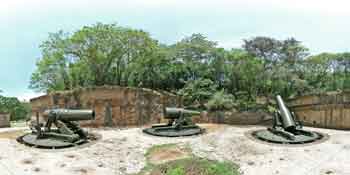
The mortars of Corregidor
Work on setting up of Battery Way started in 1904 and it was completed in 1914 at a cost of $112,969. It was named in honor of 2nd Lieutenant Henry N. Way of the 4th U.S. Artillery who died in service in the Philippines in 1900. Armed with four 12-inch mortars, it was capable of lobbing a 1000-lb deck piercing shell or 700 lb high explosive shell 14,610 yards in any direction. This gun emplacement was equipped with anti-personnel firepower. It was designed to penetrate the thin deck armor of warships and against any enemy entrenched on higher grounds in Bataan. Its firing elevation was from 45 degrees minimum to 70 degrees maximum. The length of its rifled bore is 10 ft. To fire each mortar, a standard crew consisting of 14 men were needed. Three of the serviceable mortars opened fire on April 28, 1942 and on May 2, 1942. After the 12 hours of continuous firing, the remaining mortar finally frose tight on May 6, 1942. It was the last of Corregidor’s “concrete artillery” to cease firing before the surrender of Bataan.
Mile-Long Barracks
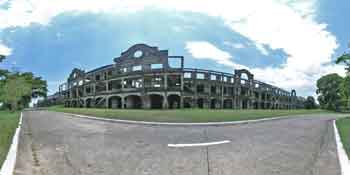
The mile-long barrack
This is a three-story concrete building which was constructed to be hurricane-proof. It was used for the billeting of American officers and enlisted personnel detailed at the garrison. The entire length of the building measures about 1,520 feet that it became popularly known as the world’s longest military barracks. Although it is just less than a third of a mile long, it was, however, commonly referred to as the Mile-Long Barracks. The headquarters of Gen. Douglas MacArthur was also located in this building.
Malinta tunnel
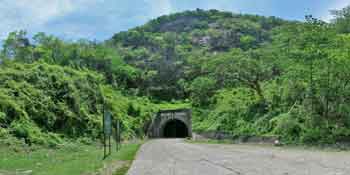
The Malinta tunnel
To the east of Bottomside a hill rises abruptly to an elevation of 390 feet. Called “Malinta,” it severs Bottomside from the tail end of the island. The North and South Shore roads curved from its slopes and girdled the hill and ran on down the curving tadpole tail. To facilitate passage and to create a bombproof shelter, the Americans drove a shaft from a rock quarry at Bottomside directly through the hill, creating the famous Malinta Tunnel. Construction of the tunnel took about 10 years. Work was initially started in 1922 and it was substantially completed in 1932. The 835 feet long East-West passage served as the main tunnel which is 24 feet wide and the height at the top of its arch is 18 feet. Branching from it are 13 laterals on its north side and another 11 laterals on the south side. Each lateral averaged 160 feet and 15 feet in length and width, respectively. A double-track electric trolley line used to run through the main tunnel which is reinforced with concrete walls, a concrete floor, and overhead arches. Blowers were installed to allow the circulation of fresh air.
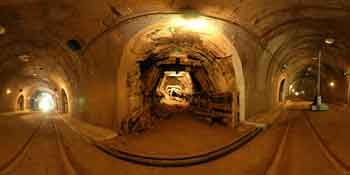
The Malinta tunnel
The tunnel had been dug through solid rock and offered complete protection from artillery or air attack. Command communications and medical units were located there. Gen. MacArthur set up the headquarters of USAFFE inside the tunnel where men and women would live and work during the siege of Corregidor. The tunnel was originally designed to house huge quantities of ammunition, food and supplies, and an underground hospital with a 1,000-bed capacity. The location of the tunnel beneath Malinta Hill made it ideal as a bomb-proof headquarters for the embattled Filipino and Americans defenders of Corregidor during World War II. During the siege of Corregidor, a number of shops and storage areas were added.
The Pacific War Memorial
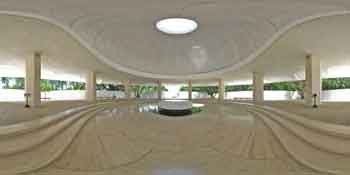
The Pacific War Memorial
The memorial was erected to honor of the Filipino and American servicemen who participated in the Pacific War. Financed with an appropriation by the United States Congress, it was completed in 1968. The major memorial structure is a rotunda in which a circular altar falls directly under the dome’s open center through which light falls on the altar during daylight hours. The altar symbolizes a wreath of victory with the following words inscribed on its rim: “Sleep, my sons, your duty done, for Freedom’s light has come; sleep in the silent depths of the sea, or in your bed of hallowed sod, until you hear at dawn the low, clear reveille of God.” The memorial also houses a museum which serves as the repository of relics and memorabilia related to the history of Corregidor.
The Japanese Garden of Peace
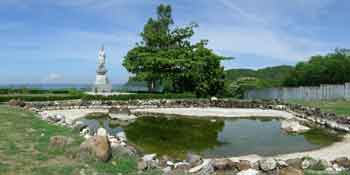
The Pacific War Memorial
This garden features a 10-foot high stone Buddha with a reflecting pool, a shinto Shrine, and other Japanese soldier memorial shrines and markers. It is also used as a praying area for Japanese war veterans and the families and relatives of Japanese soldiers who served or were killed in Corregidor during World War II. Also on display within the garden are anti-aircraft guns which are relics of the war. A small pavilion houses some Japanese memorabilia and World War II photographs. The construction of this garden was made possible through funds generated by a Japan-based private group.
© 2005 Fung Yu
Text © Corregidor island
Related websites