search site
countries
all panoramas
BreendonkLa Réunion
Corregidor
Oreshek
Hiroshima
Nagasaki
Hiroshima Dome
Hiroshima Ceremony
Okinawa battle
Okinawa landing
Yasukuni-Jinjya
Manzanar
Tokyo I
Tokyo II
Tokyo III
Pearl Harbor
KL Stutthof
Hürtgen forest
Sant'Anna Stazzema
Stuttgart
Creux-du-Van
Bunker Valentin
Theresienstadt
St-Gotthard railroad
Berlin - Memorial
Roma
Oradour-sur-Glane
Moscow
Al Alamein
Antwerp
Tallinn
Trieste
Hendaye
Coventry
Ebensee
Bastogne
Toulouse
Skæring Hede
St.Petersburg - Nevsky
London
Rab
Maloyaroslavets
Reims
Auschwitz Birkenau
Vienna - Heldenplatz
Gernika
Ryvangen
Vienna - Flaktowers
Nemecka
Brestanica
Maribor
Berlin - streets
Metlika
Hartheim Castle
Ljubljana
Cerkno
Drazgose
Yad Vashem
Berlin - Cenotaphs
Little Haldon
St.Petersburg
Babi Yar
Walcheren
Lommel
Dachau
Arnhem
Hanstholm
contact
e-mailRSS / RSS2 / atom
St.Petersburg
3 panoramas by natalia kovarskay, alexey grif
Bolshoye Zarechie
Here is the village Bolshoye Zarechie near Sant-Petersburg. On the 5th October 1943 it was completely destroyed by the German army. All 63 citizens were killed and 13 houses were burnt. It was the only village from many others, which was destroyed by German army in autumn 1943 for supporting and helping of partisans (national liberation movement).
Now it is the memorial place.
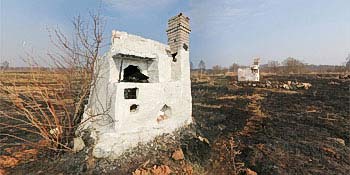
Bolshoye Zarechie
Doroga Zhizni (Road of Life)
This is the memorial for “the Road of Life”. During the WWII Leningrad (St.Petersburg) was blockaded from the rest of the country by the German and Finnish armies. The city suffered hard from starvation. The only way to supply the Leningrad and evacuate people was this road: 47 kilometres from Leningrad to the Ladoga Lake and by water in summer, or by ice in winter to the opposite side (there were two ways 30 and 135 kilometres). This road had been functioning for 3 years of the blockade.
The city was blockaded from the rest of territory of the Soviet Union on the 4th September 1941. The main food storage were destroyed on 8th September 1941. The real starvation began in October of 1941. In November 1941 the food supply for one person was limited to 250 grams of bread for workers and 125 grams for all other citizens per day. Besides bread (which for 75% consists from cellulose and other surrogates), the amount of food received during one month was only 1,5 kilogram. The first winter was very hard, but not alone. In Fabruary 1942 in Leningrad every day 20 000 people were dying from dystrophy.
900 days and nights the city lives, work and struggle in the Blockade. The circle of blockade was broken 18th January 1943 and only on the 22 January of 1944, the town was released. Up to 2 000 000 died from starving in Leningrad and 1 350 000 up to 1 750 000 were evacuated by the “Road of Life”.
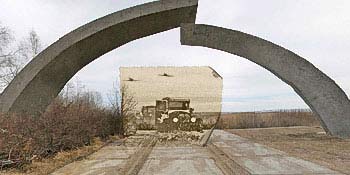
Doroga Zhizni (Road of Life)
Piskariyovskoye cemetery
What you have seen on the panorama is not the place of the battle. However, it is very closely connected with the World War II. This is the Piskariyovskoye cemetery in St.Petersburg. All the space around you and much more, you can’t see, is the common grave for the hundred thousands people. The official figures are the following: 186 common grave on the area of 26 hectares (10,52 acres or 260 000 sq. meters). 470 000 civil citizens and from 30 000 up to 100 000 soldiers. No no names, no ages. Most of these peoples died from starving in 1941-1944. The quantity of the dead was so high, and the rest people were so weak, that there was no opportunity to make individual grave for each of them. The special commands gathered cadavers on the streets, in the houses, in the public places and brought them to the cemetery, where a large pit was prepared. When the pit became full, they began the next one.
This was not the only cemetery, of such kind in St.Petersburg during the WWII, but this preserved as the memorial place. To make you understand better what had happened in Leningrad during the WWII there is a little history. The city was blockaded from the rest territory of the Soviet Union on the 4th September in 1941 by German and Finnish army. Leningrad was the largest industrial, scientific and cultural centre of the country. The main food storage were destroyed. The only connection of the city with other country was “the Road of Life”. The city suffered hard from the starvation, but the will of the people to victory was very strong. 900 days and nights the city lived, worked and struggled in the Blockade. The circle of blockade was broken on 18 January 1943 and only on the 27th January 1944, the city was released.
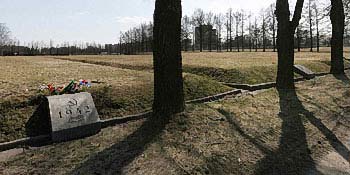
Piskariyovskoye cemetery
Figures:
107,158 air bombs, 148,478 artillery bombs, 16,744 killed, 33,782 wounded, up to 2,000,000 people starved to death.
© 2005 Natalia Kovarskay, Alexey Grif