search site
countries
all panoramas
BreendonkLa Réunion
Corregidor
Oreshek
Hiroshima
Nagasaki
Hiroshima Dome
Hiroshima Ceremony
Okinawa battle
Okinawa landing
Yasukuni-Jinjya
Manzanar
Tokyo I
Tokyo II
Tokyo III
Pearl Harbor
KL Stutthof
Hürtgen forest
Sant'Anna Stazzema
Stuttgart
Creux-du-Van
Bunker Valentin
Theresienstadt
St-Gotthard railroad
Berlin - Memorial
Roma
Oradour-sur-Glane
Moscow
Al Alamein
Antwerp
Tallinn
Trieste
Hendaye
Coventry
Ebensee
Bastogne
Toulouse
Skæring Hede
St.Petersburg - Nevsky
London
Rab
Maloyaroslavets
Reims
Auschwitz Birkenau
Vienna - Heldenplatz
Gernika
Ryvangen
Vienna - Flaktowers
Nemecka
Brestanica
Maribor
Berlin - streets
Metlika
Hartheim Castle
Ljubljana
Cerkno
Drazgose
Yad Vashem
Berlin - Cenotaphs
Little Haldon
St.Petersburg
Babi Yar
Walcheren
Lommel
Dachau
Arnhem
Hanstholm
contact
e-mailRSS / RSS2 / atom
Tokyo I
2 panoramas by keiji yokotani
Hitachi Aircraft Company
旧日立航空機株式会社
This building was a substation for the Tachikawa factory of Hitachi Aircraft Company, a munitions plant that manufactured airplane engines. It was constructed in 1938. On the outside wall remain innumerable holes as a remnant of strafings and bombings during World War II. The building was bombed three times between February and April of 1945. As many as over 110 were killed, and a great number of people were injured.
この建物は航空機のエンジンを製造する軍需工場、日立航空機株式会社立川工場の変電所でした。 1938年に建設されました。外壁に残る無数の穴は、太平洋戦争の時に機銃掃射や爆撃機の爆弾が炸裂してできたものです。 1945年2月から4月にかけて3回爆撃があり110余名の死者と多くの負傷者が出ました。
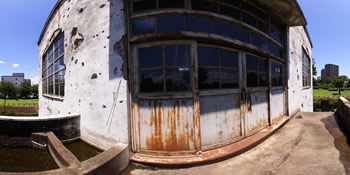
Entrance of 2nd floor
二階入口
This substation supplied electricity to the factory until December of 1993 with hardly any repairing, although the management company changed hands after the war. The building was to be demolished when the plan to organize the area into a Tokyo metropolitan-owned park was brought up. However, the citizens wished to preserve a valuable war-damaged building for passing it down to the next generation. With former employees zealously sharing the same hope, they carried out a movement, which successfully saved the substation from destruction.
この変電所は経営会社が変わった戦後もほとんど修理の手を加えず、1993年12月まで工場に電気を送り続けていました。都立公園として整備されるに当たり、一旦は取り壊される運命にありました。貴重な戦災建造物を保存し次代に伝えたいという市民の活動や、元従業員の方々の熱意がひとつの運動となり、保存されました。
In front of the building stands a part of the water tower that was demolished in 2000.It is now exhibited as a monument. Extensive damage from the bombings remain on the surface of the water tower as well.
建物手前にあるのは、平成12年に取り壊された給水塔の一部が、モニュメントとして展示されているものです。給水塔の表面にも多くの爆撃の跡が残っています。
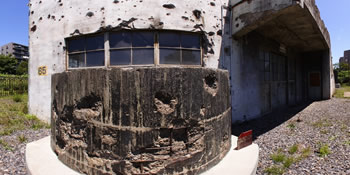
Part of the water tower
給水塔の一部
Higashiyamato-shi, a city in Tokyo where this former substation stands, designated this building as a cultural property (specifically historic site) in October, 1995, and repaired the building in order to preserve it and open it to public in the long future. War-damaged buildings have been torn down one after another, and our memories of the war is fading today. Higashiyamato-shi board of education says they hope the scarred building will bring home to people the misery of war and the pricelessness of peace.
Now, the building is surrounded by a park, where people enjoy themselves peacefully. The scene we see today contrasts with the tragedy that took place 60 years ago.
東京都東大和市は1995年10月に、この建物を東大和市文化財(史跡)として指定し、末永く保存し公開するために修復工事を施しました。戦争の傷跡を残す建物は次々に取り壊され、戦争に対する私たちの記憶もうすらいできています。東大和市教育委員会は、この建物から、戦争の悲惨さと平和の尊さを改めて受けとめていただきたいと願っているとのことです。建物を取り囲み、公園が存在します。そこには、戦争の傷跡とは対局の市民の穏やかな風景があります。
In closing, I would like to express my gratitude to Higashiyamato-shi board of education for showing understanding over the purpose of this project, and giving me special permission to photograph the building.
Comments above are written based on information from the exhibition.
このプロジェクトの目的をご理解頂き、特別の撮影許可を下さった東大和市教育委員会に感謝します。なお、解説は展示資料を参考とさせて頂きました。
Translation by Yuko Kato
英訳 加藤優子
© 2005 by Keiji Yokotani
横谷恵二
related websites