search site
countries
all panoramas
BreendonkLa Réunion
Corregidor
Oreshek
Hiroshima
Nagasaki
Hiroshima Dome
Hiroshima Ceremony
Okinawa battle
Okinawa landing
Yasukuni-Jinjya
Manzanar
Tokyo I
Tokyo II
Tokyo III
Pearl Harbor
KL Stutthof
Hürtgen forest
Sant'Anna Stazzema
Stuttgart
Creux-du-Van
Bunker Valentin
Theresienstadt
St-Gotthard railroad
Berlin - Memorial
Roma
Oradour-sur-Glane
Moscow
Al Alamein
Antwerp
Tallinn
Trieste
Hendaye
Coventry
Ebensee
Bastogne
Toulouse
Skæring Hede
St.Petersburg - Nevsky
London
Rab
Maloyaroslavets
Reims
Auschwitz Birkenau
Vienna - Heldenplatz
Gernika
Ryvangen
Vienna - Flaktowers
Nemecka
Brestanica
Maribor
Berlin - streets
Metlika
Hartheim Castle
Ljubljana
Cerkno
Drazgose
Yad Vashem
Berlin - Cenotaphs
Little Haldon
St.Petersburg
Babi Yar
Walcheren
Lommel
Dachau
Arnhem
Hanstholm
contact
e-mailRSS / RSS2 / atom
Yad Vashem
4 panoramas by yaniv sirton
Righteous Among the Nations
The Avenue and Garden of the Righteous Among the Nations honor the non-Jews who acted according to the most noble principles of humanity and risked their lives to help Jews during the Holocaust.
2000 trees, symbolic of the renewal of life, have been planted in and around the avenue.
Plaques adjacent to each tree give the names of those being honored along with their country of residence during the war.
A further 18,000 names of non-Jews recognized to date by Yad Vashem as Righteous Among the Nations, are engraved on walls according to country, in the Garden of the Righteous Among the Nations.
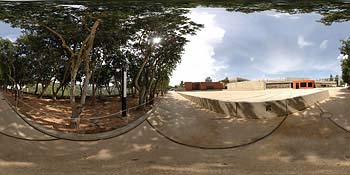
Avenue of the Righteous Among the Nations
Children’s Memorial
This unique memorial, hollowed out from an underground cavern, is a tribute to the approximately 1.5 million Jewish children who perished during the Holocaust.
Memorial candles, a customary Jewish tradition to remember the dead, are reflected infinitely in a dark and somber space, creating the impression of millions of stars shining in the firmament.
The names of murdered children, their ages and countries of origin can be heard in the background.
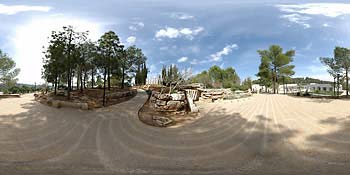
Entrance to the Children’s Memorial
Pillar of Heroism (1968)
At the end of a path paved with smooth stones and bounded on both sides by blocks of grey concrete symbolizing the destruction, there rises the Pillar of Heroism, commemorating Jewish resistance during the Holocaust.
The towering pillar is reminiscent of the chimneys of the crematoria, but unlike the chimneys, this pillar is open to the elements.
The inscription on the concrete blocks reads: “Now and forever in memory of those who rebelled in the camps and ghettos, fought in the woods, in the underground and with the Allied forces; braved their way to Eretz Israel; and died sanctifying the name of God.”
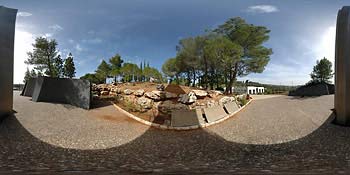
Pillar of Heroism
Korczak and the Ghetto’s Children, (1978)
Located in the Janusz Korczak Square, this sculpture of the great Polish-Jewish educator Dr. Henrik Goldschmidt (known by his pseudonym Janusz Korczak) stands in the center of a group of children and shelters them with his body and his outstretched, embracing arms.
The figure of Korczak is considerably bigger than the figures of the children. Only his face and hands are visible, uniting the group with their embrace.
The children are tall and skinny, their hands long and lifeless and their heads drooping.
Janusz Korczak and the children of his orphanage were sent to the Treblinka death camp on August 5, 1942. Every year on this date a memorial ceremony is held at the monument, attended by members of the Korzcak Society in Israel, including several of the children under his care who survived the war.
Janusz Korczak started working with children at summer camps, and in 1908, commenced his work with orphans.
In 1912 he was appointed head of the new Jewish orphanage in Krochmalna Street, Warsaw. At the orphanage, Korczak put his educational theories and methods to the test, and succeeded in unlocking the door to the children’s hearts and souls.
The basic tenets of Korczak’s theory are an understanding of the emotional world of the child, and an attitude of respect towards him/her. He wrote many books, and during the occupation he kept a diary. After the war, many organizations were established in his name, keeping his memory alive, and cultivating his educational techniques.
His writings have been translated into several languages, and books and plays have been written about him.
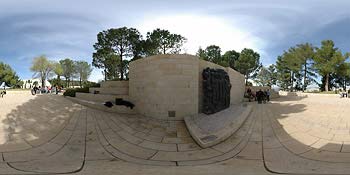
Korczak and the Ghetto’s Children
Text and information by Yad Vashem public relations
(special thanks to Lilach Tamir)
© 2005 Yaniv Sirton
Related websites
Visit Yad Vashem memorial